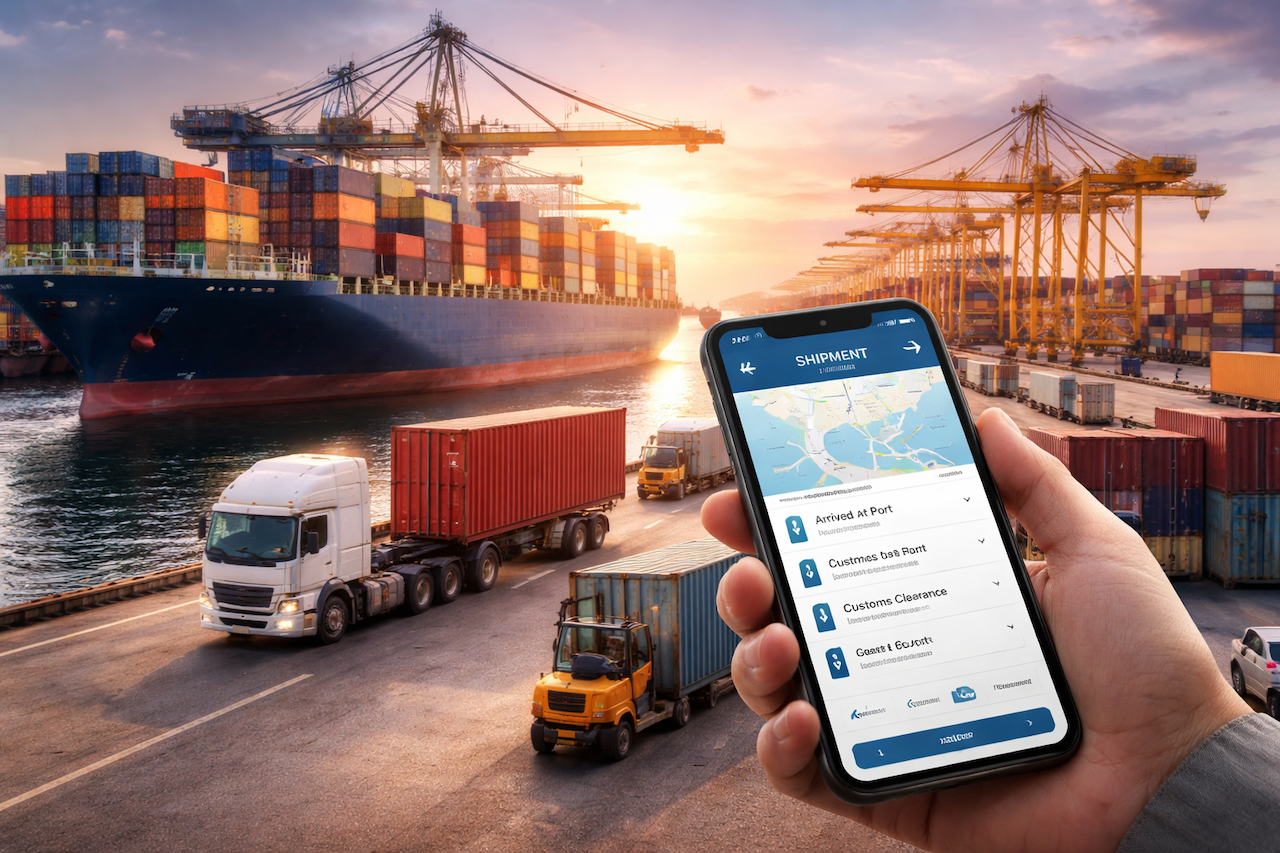
For decades, maritime logistics has been built on tangible assets—vessels, terminals, cranes, and infrastructure measured in millions of dollars and thousands of tons. Competitive advantage was easy to explain: bigger fleet, better coverage, stronger position. But here is the uncomfortable reality.
Your customer never sees your fleet. They do not stand on the deck when the vessel departs. They do not watch the container being loaded. They do not experience your operational excellence in real time. What they actually interact with is far more mundane—and far more decisive: email threads, delayed updates, missing documents, and, increasingly, your digital interface.
In practice, the perceived quality of a shipping service is no longer formed at sea or at the terminal. It is formed on a screen. And this is where many logistics companies quietly lose the competition.
The Real Customer Interface: Not the Ship, but the Screen
A vessel moves cargo. An interface moves perception. For the customer, the shipping process is not a physical experience but an informational one. They do not evaluate engine performance or port efficiency. They evaluate how quickly they receive updates, how clearly delays are explained, and how easily they can access the documents they need.
In this sense, the mobile app—or any digital interface—has quietly become the front office of maritime logistics.
Consider the contrast. A company may operate a modern fleet, optimize routes, and maintain high operational standards. Yet if the customer is left refreshing an outdated tracking page, waiting hours for a reply, or searching through email attachments for a bill of lading, the perceived service quality collapses. The operational excellence remains invisible; the communication failure becomes the reality. What replaces it is frustration—and, eventually, churn.
This shift changes the nature of competition. It is no longer enough to move cargo efficiently. You must make the movement visible, understandable, and predictable to the client. And that happens not at sea, but on the screen in their hand.
In modern logistics, the interface is not a supporting tool. It is the service itself.
Where Traditional Communication Breaks Down
If you map a typical shipment, the operational chain may be well structured. The communication around it rarely is. Most interactions still rely on fragmented channels: email threads with multiple recipients, forwarded messages without context, spreadsheets attached and reattached in slightly different versions. A single update may pass through an agent, then a forwarder, then a client—each time losing clarity, timing, or both. There is no single source of truth. Only versions of it.
The result is predictable. Customers ask the same questions repeatedly because they cannot find reliable answers. Operators spend time responding not to problems, but to uncertainty. Delays, when they occur, are not just operational issues—they become communication failures. And this is where tension escalates. A delay explained in advance is manageable. A delay discovered by the client is a problem. A delay discovered late, without context, becomes a dispute.
Traditional communication channels were never designed to handle the complexity and speed of modern logistics. They create noise where there should be structure, and ambiguity where there should be clarity. In such an environment, even well-run operations appear unreliable.
One Shipment, Dozens of Interactions
A shipment may look like a single transaction on paper. In reality, it is a chain of constant interactions.
It starts with a booking request and confirmation. Then come document exchanges—commercial invoices, packing lists, bills of lading. Customs procedures introduce another layer of coordination. During transit, the client expects updates. Upon arrival, there are notices, scheduling, and delivery arrangements. If something goes wrong, the process continues into claims and dispute resolution. Each of these steps is not just an operational milestone. It is a communication moment. And each moment carries risk.
Without structure, information fragments across channels. A document is sent but not acknowledged. An update is shared but not seen. A change occurs, but not all stakeholders are informed at the same time. The more parties involved—carriers, agents, forwarders, customs brokers—the higher the вероятность that something will be missed. What should be a controlled flow becomes a sequence of interruptions.
The problem is not the number of interactions. Logistics has always been complex. The problem is the lack of a unified environment where these interactions can be managed, tracked, and understood in context.
When communication is fragmented, the shipment is no longer just moving through ports and borders. It is moving through uncertainty.
What a Good Mobile App Actually Changes
Most logistics apps do not fail because they lack features. They fail because they replicate the same fragmented processes in a slightly cleaner interface. A good mobile app does something different. It introduces structure where there was none.
First, it centralizes communication. Instead of scattered emails and disconnected conversations, all stakeholders interact within a single thread tied to a specific shipment. Context is preserved. Questions and answers remain visible. The need to “loop in” participants disappears.
Second, it makes visibility real. Not in the form of static tracking pages, but as a sequence of events that reflects what is actually happening. The customer does not just see that a container is “in transit”—they understand where it is in the process and what comes next.
Third, it brings documents into a controlled environment. No more searching through inboxes for the latest version of a bill of lading or invoice. Documents are attached to the shipment, updated in place, and accessible at any time. Version confusion is eliminated.
Finally, it changes the timing of communication. Instead of reacting to customer requests, the system pushes information proactively. Delays, changes, and key milestones are communicated before the client has to ask. This alone transforms the tone of the relationship—from reactive to predictable.
None of these changes are technically complex. But together, they redefine how the service is experienced.
From Operations Tool to Relationship Platform
Most logistics applications were never designed for customers. They were built as internal systems—tools to manage bookings, track containers, handle documentation—and only later exposed to clients as an additional interface. As a result, they reflect internal logic, not customer needs. The user is expected to adapt to the system, rather than the system adapting to the user. This is where the shift begins.
A customer-facing mobile app cannot be just a window into operations. It must be designed as a relationship platform. That means prioritizing clarity over completeness, context over raw data, and communication over control.
The difference is subtle but critical. An operations tool answers the question: what is happening? A relationship platform answers: what does it mean for me?
In practice, this changes everything. Updates are not just logged—they are explained. Events are not just recorded—they are contextualized within the shipment journey. Communication is not an afterthought—it is the core function.
When this shift happens, the app stops being a utility and becomes a point of trust. Clients no longer chase information. They rely on it.
And in logistics, trust is what determines whether the next shipment stays—or goes elsewhere.
The Cost of Poor Digital Experience
Poor communication does not appear on a balance sheet. Its consequences do. When customers lack clear, timely information, their behavior changes. They begin to hedge—requesting more updates, copying more people into emails, double-checking every step. What should be a streamlined process turns into a series of контрольних запитів. The workload increases, not because operations are failing, but because trust is. This has a direct cost.
Support teams spend time answering repetitive questions instead of resolving real issues. Managers get pulled into situations that escalated unnecessarily. Response times slow down across the board, reinforcing the very perception of unreliability that caused the problem in the first place.
At the same time, commercial impact begins to surface. Customers who feel uncertain become more price-sensitive. If the experience is inconsistent, there is little reason to stay loyal. The next offer—slightly cheaper, slightly more responsive—becomes an easy decision. What is lost is not just a shipment, but continuity.
There is also a less visible cost: disputes. When information is fragmented or delayed, disagreements are harder to resolve. Without a shared, transparent record of events, every issue becomes a matter of interpretation. This extends resolution time, strains relationships, and, in some cases, leads to financial loss.
None of this is caused by a single failure. It is the accumulation of small gaps in communication. Individually, they seem manageable. Together, they redefine the service.
What Shipping Companies Get Wrong
The problem is not that logistics companies ignore digital tools. It is how they approach them.
Too often, applications are built as extensions of internal systems. The logic is simple: expose existing processes to the client, add a tracking page, attach documents, and call it a customer portal. Technically, everything is there. Practically, very little changes. The mistake lies in perspective.
Instead of asking how the customer experiences a shipment, companies focus on how operations are structured internally. The result is an interface that mirrors organizational complexity—multiple statuses, unclear terminology, fragmented views—without resolving it.
Another common issue is misplaced investment. Effort goes into adding features, dashboards, and, increasingly, “smart” functionality. Yet the basics remain unresolved: inconsistent updates, lack of context, slow communication. The system becomes more sophisticated, but not more useful.
There is also a tendency to treat the app as a secondary channel. Something optional. Something “nice to have.” Meanwhile, customers continue to rely on email and manual follow-ups because the digital interface does not provide enough confidence to replace them.
In the end, the technology is not the problem. The intent is. When the goal is to digitize operations, the result is an internal tool. When the goal is to improve relationships, the result is a different kind of product entirely.
Table: Traditional vs Digital Customer Experience in Logistics
| Aspect | Traditional Approach | Mobile App–Driven Approach |
|---|---|---|
| Communication | Fragmented email chains, multiple contacts | Centralized, shipment-based communication |
| Visibility | Delayed, static updates | Real-time, event-driven updates |
| Documents | Attachments scattered across inboxes | Stored in one place, always accessible |
| Customer Effort | High — constant follow-ups required | Low — information delivered proactively |
| Issue Resolution | Reactive, often escalated | Faster, structured, transparent |
| Trust Level | Unstable, dependent on individuals | Consistent, system-supported |
| Customer Loyalty | Price-driven, легко змінюється | Experience-driven, more stable |
What to Build Instead
If the goal is to improve customer relationships, the starting point is not technology. It is the customer journey.
A useful mobile app does not try to replicate every internal process. It selects what matters to the client and presents it in a way that reduces effort, not adds to it.
This begins with simplicity. The interface should show a clear shipment timeline—what has happened, what is happening now, and what comes next. Not a list of technical statuses, but a coherent sequence that reflects the real flow of the shipment. The client should not need to interpret the system.
Communication must be structured. Each shipment should have its own context: messages, updates, documents—all in one place. No switching between channels, no searching through history. When a question arises, it is asked and answered within the same environment, visible to all relevant parties.
Human support should not disappear—it should be integrated. The app is not a replacement for people. It is a framework that makes interaction with people faster, clearer, and more efficient. When escalation is needed, it happens inside the system, not outside of it.
Finally, the logic must be mobile-first. Not in the sense of screen size, but in the sense of usage. Clients check updates on the move, between meetings, under time pressure. The system should reflect that reality: fast to open, easy to understand, and immediately useful.
What emerges is not a complex platform, but a reliable one. And in logistics, reliability—especially in communication—is what customers remember.